“Chemistry is so hard to learn!” “I hate organic chemistry!”
If either of those sounds like something you have said recently, you are not alone — and you are in exactly the right place.
These O-Level Chemistry study tips are techniques that produce real results. They are not about studying harder. Instead, they are about studying smarter — knowing what to focus on, how to organise it, and how to make sure it actually stays in your memory when it matters most.
Therefore, if you are ready to stop dreading Chemistry and start scoring in it, read on.
Why Chemistry Feels Overwhelming
Chemistry combines content memorisation, mathematical calculation, conceptual understanding, and practical application — all within the same syllabus. As a result, students often feel like there is too much to cover and not enough time to cover it.
Furthermore, topics like organic chemistry and electrochemistry introduce entirely new ways of thinking that feel disconnected from earlier chapters. This makes it easy to feel lost before you even begin.
However, Chemistry is also one of the most structured subjects in the Singapore curriculum. Consequently, a structured approach to revision is extremely effective. These three O-Level Chemistry study tips give you exactly that structure.
Why Chemistry Feels Overwhelming
Chemistry combines content memorisation, mathematical calculation, conceptual understanding, and practical application — all within the same syllabus. As a result, students often feel like there is too much to cover and not enough time to cover it.
Furthermore, topics like organic chemistry and electrochemistry introduce entirely new ways of thinking that feel disconnected from earlier chapters. This makes it easy to feel lost before you even begin.
However, Chemistry is also one of the most structured subjects in the Singapore curriculum. Consequently, a structured approach to revision is extremely effective. These three O-Level Chemistry study tips give you exactly that structure.
O-Level Chemistry Study Tip 1: Read the SEAB Syllabus Learning Outcomes First
If you have been following our Lock In Series, this tip will sound familiar.
We shared this method in Part 1 for Biology and Part 2 for Physics. It applies equally to Chemistry, and it is consistently the most impactful change a student can make to their revision approach.
Start every chapter by reading its learning outcomes in the SEAB syllabus document.
The learning outcomes tell you precisely what Cambridge or your school will test you on. As a result, your revision has a clear direction from the very first minute. You stop jumping between topics randomly and start working through a logical, structured checklist instead.
This matters especially in Chemistry, where the content volume is significant. Without the learning outcomes as your guide, it is easy to over-study some chapters while unknowingly leaving gaps in others.
Moreover, the learning outcomes use command words that tell you how to present your answer in the exam:
- State → A short, precise fact — no elaboration needed
- Define → A concise definition using the correct chemical terminology
- Describe → A step-by-step account of a process or observation
- Explain → The reason or mechanism behind a chemical behaviour
- Deduce → Use given information to arrive at a logical conclusion
- Calculate → Show full working, include units, and round appropriately
For instance, if a learning outcome says “explain why electronegativity increases across a period”, a simple definition of electronegativity earns zero marks. You need a mechanism — nuclear charge, atomic radius, and shielding. The command word tells you this before you even sit in the exam hall.
In short, reading the learning outcomes before you begin a chapter takes five minutes. However, it makes every hour of revision significantly more targeted and productive.
📎 SEAB 2026 Chemistry Syllabus — Download Links
- GCE O-Level Chemistry (6092): Download PDF
- GCE A-Level H2 Chemistry (9476): Download PDF
O-Level Chemistry Study Tip 2: Build Mindmaps for Content-Heavy Topics
Chemistry is, without question, a content-heavy subject. Organic chemistry alone introduces dozens of functional groups, reactions, reagents, conditions, and observations. Consequently, staring at pages of dense text is one of the least effective ways to revise it.
Mindmaps transform a wall of text into a visual structure you can actually navigate.
Instead of reading linearly, a mindmap lets you see how concepts connect — which reactions belong to which functional group, which properties distinguish alkanes from alkenes, which conditions are required for each reaction type. This visual organisation makes the content far easier to recall under exam pressure.
Topics That Benefit Most from Mindmaps in O-Level Chemistry
- Organic Chemistry — central node: the functional group; branches: reactions, reagents, conditions, observations, products
- The Periodic Table — central node: each group or period; branches: trends in properties, reactivity, physical characteristics
- Electrochemistry — central node: electrolysis; branches: electrolytes, electrodes, products at each electrode, factors affecting discharge
- Acids, Bases, and Salts — central node: salt preparation method; branches: reactions, steps, suitable reactants
Use Colour-Coding as a Memory Tool
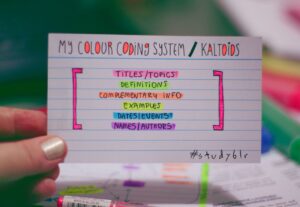
Colour-coding within your mind maps adds a second layer of organisation. Furthermore, it builds a subconscious association between colour and information type over time during the exam.
Here is a simple system you can adopt immediately:
- 🔵 Blue → Definitions and chemical laws
- 🟣 Purple → Chemical equations and formulae
- 🟡 Yellow → Processes and step-by-step reactions
- 🔴 Red → Conditions, exceptions, and common mistakes to avoid
The colour association does not need to be elaborate. However, it does need to be consistent — use the same colours across every mindmap so the system becomes automatic over time.
Physically drawing and colour-coding your mind maps is also significantly more effective than typing them. The act of writing reinforces memory in a way that typing alone does not.
O-Level Chemistry Study Tip 3: Use Spaced Repetition to Beat the Forgetting Curve
“It’s on the tip of my tongue — I swear I read it somewhere in my notes!”
Every student has experienced this during an exam. You studied the content. You understood it at the time. However, when you need it most, it is frustratingly just out of reach.
This is not a memory problem. It is a revision timing problem.
https://elearningindustry.com/forgetting-curve-combat
The Ebbinghaus Forgetting Curve
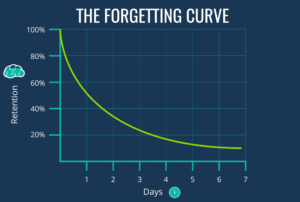
In 1885, German psychologist Hermann Ebbinghaus systematically studied how the human brain forgets information over time. His findings produced what is now known as the Ebbinghaus Forgetting Curve — a model showing that without reinforcement, we forget new information within days of learning it.
Specifically, without review:
- After 20 minutes, you retain roughly 60% of new information
- After 1 day, you retain approximately 35%
- After 7 days, retention drops to around 20%
This explains why cramming the night before an exam produces such poor results. You temporarily push information into short-term memory. However, it disappears almost as fast as it arrived.
Spaced Repetition: The Ultimate Guide to Remembering What You Learn
The Fix: Spaced Repetition
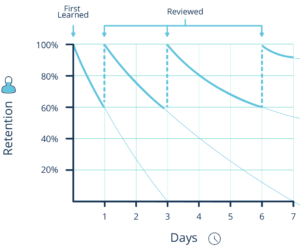
Spaced repetition is the practice of reviewing information at increasing intervals over time — rather than all at once in a single sitting.
For example, instead of reading your Organic Chemistry notes once for three hours, you revise them briefly today, then again in three days, then again in one week, then again in two weeks. Each review reinforces what you already remember and simultaneously fills in gaps in your recall.
As a result, information moves from short-term memory into long-term memory. Therefore, on exam day, you are not trying to recall something you crammed yesterday. Instead, you are retrieving something you have reviewed multiple times over weeks.
How to Apply Spaced Repetition to Chemistry Revision
- Flashcards work especially well for Chemistry definitions, chemical equations, and organic reaction conditions. Apps like Anki automatically schedule your reviews at optimal intervals.
- Weekly review sessions — dedicate 20 minutes per week to re-reading mindmaps from previous chapters, even after you have moved on to new content.
- Active recall — instead of re-reading notes, close them and try to recall the content first. Then check your notes and correct any gaps. This forces your brain to retrieve the information, which strengthens the memory trace far more effectively than passive re-reading.
The key principle is this: little and often beats a lot at once, every single time.
Your Chemistry Revision Framework — Summarised
These O-Level Chemistry study tips address the three most common failure points in Chemistry revision: not knowing what to study, getting lost in dense, unorganised content, and forgetting what was studied too quickly.
Here is the framework in three steps:
- Know what will be tested — read the SEAB learning outcomes before opening your notes for any chapter, and note the command words for each outcome
- Reorganise your notes into mindmaps — colour-coded by information type, built by hand, topic by topic
- Space out your repetition — review previous content regularly at increasing intervals so it encodes into long-term memory
Chemistry is undoubtedly an intense subject. However, it is also one of the most learnable — because its content is fixed, its command words are predictable, and its question formats repeat year after year. The students who score well are rarely the most naturally gifted. Instead, they are the most methodical.
Need More Than Tips? Get Expert Chemistry Tuition at ClearMinds Toa Payoh
Study techniques give you the right habits. However, sometimes what a student truly needs is a teacher who can identify exactly where their understanding breaks down — and re-explain the concept in a way that finally makes sense.
At ClearMinds Education in Toa Payoh, our Chemistry classes are designed for both Secondary and JC students. Whether you are preparing for O-Level Chemistry or A-Level H2 Chemistry, our ex-MOE teachers provide:
- Lessons structured directly around the SEAB learning outcomes
- Guided mind-mapping and note organisation techniques embedded into lessons
- Clear, step-by-step explanations of organic chemistry mechanisms
- Personalised feedback on your exam answers — not just the marks, but the reasoning
- Small group classes where every question gets a complete, patient answer
Our Chemistry tuition at ClearMinds Toa Payoh is part of a Science tuition programme that has helped students across Toa Payoh, Braddell, and Bishan significantly improve their Chemistry grades — many within a single school term.
If you found the study tips in Part 1 (Biology) and Part 2 (Physics) useful, the same structured approach runs through every subject we teach at ClearMinds.
Ready to lock in your Chemistry grade? Book a trial class from just $5 at clearmindstuition.com.sg or WhatsApp us at +65 8388 0505.
📍 ClearMinds Education | 148 Lorong 1 Toa Payoh, #01-903, Singapore 310148 Near Toa Payoh MRT and Braddell MRT 🌐 clearmindstuition.com.sg | 📞 +65 8388 0505
Next in the Lock In Series → How to Score in Your Mathematics Paper: The Method-First Approach